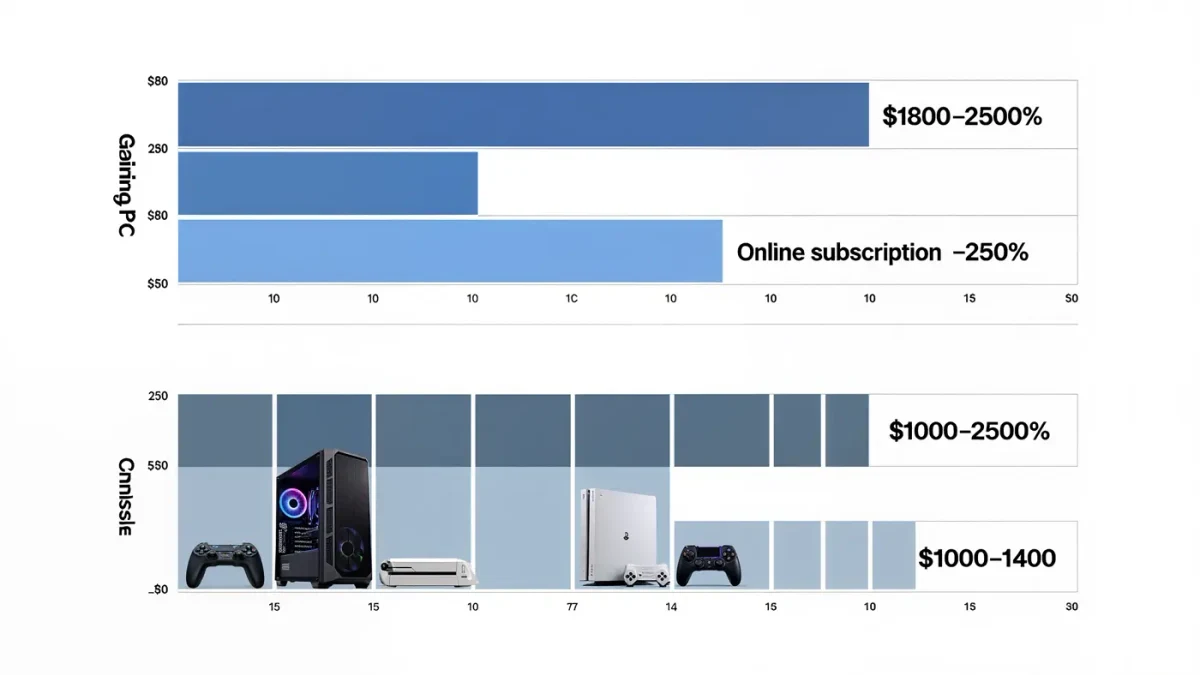
Counted over five years, a mid-range gaming PC and a current-generation console end up closer in total cost than either camp admits: the console wins the day-one purchase by roughly the price of a decent graphics card, but the PC claw it back through cheaper games, free online play, and no subscription requirement. Which one actually costs you less depends on how many games you buy and whether you would pay for online multiplayer anyway. Here is the honest arithmetic, line by line.
Casino Game Guru publishes information, not purchasing advice. Prices below reflect the US market as of late 2025 and shift with sales; treat every number as a range, not a quote.
What does each platform cost up front?
Through 2025, current-generation consoles typically sold for roughly $450–600 depending on model and disc drive, with mid-generation refreshes at the top of that band. A gaming PC capable of similar performance — console-class settings at 1440p — realistically started around $700–900 prebuilt in late 2025, and less if you build it yourself or buy used parts. The up-front gap is real: expect to pay a few hundred dollars more to enter on PC.
That gap buys things a console does not offer: keyboard-and-mouse input, mod support, free choice of storefronts, backwards compatibility reaching back decades, and a machine that also handles work applications. Whether those are worth the premium is a preference question, not a math question.
What do games cost on each side?
This is where the gap narrows fast. Big console releases launch at $60–70 and hold near that price for months on the PlayStation and Xbox stores, with deep discounts arriving mainly in scheduled seasonal sales. On PC, the same titles launch at the same prices — but the discount cycle is faster and deeper, because multiple competing storefronts run frequent sales, and key resellers exist (with the caveat that gray-market keys carry real risks: revoked games, no refunds, no publisher support).
Over a five-year window, a player buying 8–10 full-price games a year can realistically save several hundred dollars on PC through discounts alone. A patient buyer who waits for sales on either platform shrinks that advantage considerably.
What about online play and subscriptions?
This line item only exists on console. Playing multiplayer online on PlayStation or Xbox requires a paid subscription — roughly $60–80 a year at list price through 2025. Nintendo charges less for a more limited service. On PC, online multiplayer is free: no platform gate sits between you and the game servers. Five years of console online play adds up to roughly $300–400 — often more than the entire up-front price gap between the two platforms.
Subscriptions cut both ways, though. Game-pass-style catalogs on console (and on PC) offer large libraries for a monthly fee. If you play many short games, a subscription can be cheaper than buying; if you replay a few favorites, it is money that buys nothing permanent. Neither platform has a monopoly on that trade.
Five-year totals: a worked example
Illustrative comparison, list prices, late 2025, assuming 8 full-price-equivalent game purchases per year:
| Cost line | Console (5 years) | PC (5 years) |
|---|---|---|
| Hardware | $450–600 | $700–900 |
| Online multiplayer | $300–400 | $0 |
| Games (8/yr, after typical discounts) | $2,000–2,600 | $1,600–2,200 |
| Storage upgrade | $80–150 | $50–150 |
| Indicative total | $2,830–3,750 | $2,350–3,250 |
The table is a shape, not a quote: peripherals, regional pricing, secondhand sales, and upgrade habits move every row. Its honest lesson is that the totals overlap — the platforms cost within a few hundred dollars of each other for a typical buyer, not thousands apart.
Do PC upgrades erase the savings?
They can. The console's pitch is fixed: one purchase, eight to nine years of the same hardware running every game made for it. A PC has no such guarantee — parts age unevenly, and the tempting path of upgrading the graphics card midway through can cost more than a whole new console. The disciplined answer is to treat a gaming PC like a console: buy sensible mid-range parts, run them for five to seven years, and upgrade once, not annually. Players who resist the upgrade treadmill keep the PC's cost advantage; players who enjoy tinkering pay for the hobby, and that is a legitimate choice too.
What does each platform cost to keep running?
Consoles are appliance-simple: low power draw, near-zero maintenance, repairs usually meaning a replacement. PCs need occasional attention — driver updates, dust cleaning, Windows housekeeping — and use more electricity under load, which adds a modest amount to annual running cost. Against that, a PC is repairable part by part, while a failed console out of warranty is usually a full replacement. Over five years the maintenance costs roughly wash; the difference is who does the work.
Which hidden costs do people forget?
- Peripherals — a monitor that shows what the PC can do costs real money; consoles assume you own a TV.
- Game prices at launch — identical on both, but the PC discount cycle is faster.
- Resale — physical console discs can be resold; PC licenses generally cannot.
- Free games — the Epic Games Store's weekly free giveaways continued through 2025, a small but real PC-only saving.
So which is cheaper?
For a heavy buyer who plays online multiplayer and takes advantage of discounts, the PC usually wins over five years despite the higher entry price. For a light buyer — two or three games a year, single-player, happy with a TV — the console is clearly cheaper and simpler. Anyone quoting a one-line answer to this question is selling something; the honest answer is a small spreadsheet with your own habits in it.
For more context, read Prebuilt vs. Custom Gaming PC: Which to Choose in 2026.
For more context, read steam refund policy.
For more context, read SSD vs. HDD for PC Gaming: What Load Times Really Cost.