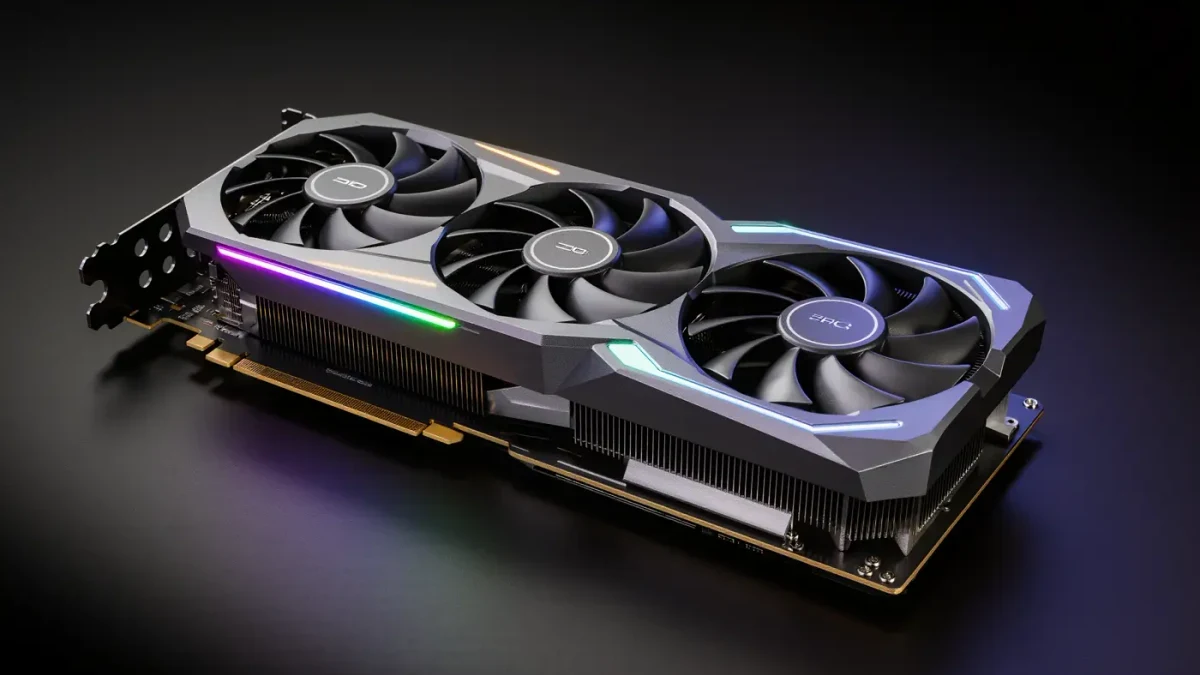
DLSS (NVIDIA) and FSR (AMD) are upscaling technologies: the game renders at a lower internal resolution and an algorithm reconstructs it to your monitor's full resolution, typically returning 30–60% more frame rate for a small, usually hard-to-spot loss in fine detail. By 2025 both had become standard options in most major PC releases, and Intel's XeSS had joined them as a third cross-vendor option. The honest difference between them is method and hardware: DLSS runs machine-learning reconstruction on dedicated tensor cores in NVIDIA's RTX cards, while FSR (in its FSR 3 form through 2025) is an open algorithm that runs on almost any modern GPU, including NVIDIA's and Intel's.
Casino Game Guru publishes information, not purchasing advice. This explainer describes what each technology does and what the trade-offs actually are, per each vendor's published documentation as of 2025.
What problem is upscaling solving?
Raw pixels are expensive. Rendering at 4K means shading 8.3 million pixels per frame; rendering at 1440p means 3.7 million — less than half the work. Upscaling lets the GPU do the small render and then scale it up intelligently, spending the saved horsepower on frame rate instead. A quality-mode upscale from 1440p to 4K typically costs little visible detail; a performance-mode upscale from 1080p to 4K is faster still but visibly softer. The technique is a dial, not a switch: the lower the internal resolution, the bigger the gain and the bigger the compromise.
How does DLSS work?
Per NVIDIA's documentation, DLSS uses a neural network running on the tensor cores found in every RTX GPU (the 20-series and newer). The model receives the low-resolution frame plus motion vectors — data describing how objects moved — and reconstructs a high-resolution image, using temporal information from previous frames. DLSS 2 and later versions made quality broadly resolution-dependent rather than game-specific, so results looked similar across titles. DLSS 3 added Frame Generation, which synthesizes entire intermediate frames and can double the displayed frame rate on RTX 40-series cards, at the cost of a small amount of added input latency and occasional artifacts around fast, thin objects. Through 2025, ray-reconstruction features and refined frame generation continued to arrive in later revisions.
How does FSR work?
Per AMD's documentation, FSR is an open spatial-temporal upscaling pipeline that runs on standard GPU hardware — AMD cards from the RX 5000 series onward, and NVIDIA and Intel cards too. FSR 1 was purely spatial (scaling the image without motion data); FSR 2 brought temporal reconstruction comparable in approach to DLSS; FSR 3 added Fluid Motion Frames, AMD's frame generation, again cross-vendor. Because it uses no dedicated ML hardware, FSR historically paid for its openness with somewhat more visible softness and shimmer in fine detail like fences and foliage, though the gap narrowed with each generation. Its cross-vendor support is the strategic point: it is the reason upscaling became a checkbox in nearly every major release rather than an NVIDIA-exclusive feature.
DLSS vs. FSR: what actually differs in practice?
| Aspect | DLSS (NVIDIA) | FSR (AMD) |
|---|---|---|
| Hardware required | RTX 20-series or newer | Near-any modern GPU, all vendors |
| Method | Neural network on tensor cores | Open temporal upscaling algorithm |
| Image quality | Generally the reference standard | Close; softer in fine detail |
| Frame generation | DLSS 3 FG, RTX 40-series+ | FSR 3 FMF, cross-vendor |
| Openness | Proprietary | Open source (upscaler) |
On a game offering both, the common finding in 2024–2025 comparisons: DLSS slightly ahead on image stability, FSR close behind and universally available. On an RTX card, use DLSS; on anything else, FSR or XeSS are genuine features, not consolation prizes.
What about Intel XeSS?
Intel's XeSS, introduced with Arc graphics in 2022, splits the difference in a clever way: on Intel Arc cards it runs a neural model on XMX hardware, while on other vendors' GPUs it falls back to a cross-compatible mode. Its DP4a path runs on NVIDIA and AMD hardware, and image quality in 2024–2025 titles frequently landed between FSR and DLSS. In games that offer all three, the practical ranking rarely changes the experience as much as the quality mode you pick does.
Which quality mode should you choose?
The modes are internally consistent across vendors — they set the internal render resolution as a fraction of output:
- Quality — ~67% per axis (1440p internal for 4K output). The mode to default to: large gains, minimal cost.
- Balanced — ~58% per axis. Reasonable on smaller screens.
- Performance — ~50% per axis (1080p internal for 4K). Visible softening; best reserved for when frames are genuinely scarce.
- Ultra Performance — ~33% per axis. Clear artifacts; esports-only territory.
The higher your output resolution, the better upscaling looks — a 4K quality-mode image reconstructs from more source data than a 1080p one. At 1080p output, upscaling is often not worth enabling at all.
What does frame generation add — and cost?
Frame generation is a separate feature from upscaling even though the menus sit together. It interpolates new frames between rendered ones, raising displayed FPS and motion smoothness substantially — but the generated frames are not produced from fresh input, so responsiveness does not improve to match, and a small latency penalty applies. The honest rule: frame generation makes an already-playable game smoother; it does not rescue an unplayable one. It suits third-person action and slow camera work far better than competitive shooters, where latency is the currency.
Is native resolution still the quality reference?
Increasingly, not always. Temporal reconstruction from a clean, well-antialiased internal image can look better than a noisy native render with standard anti-aliasing — a comparison DLSS made famous. The old shorthand "native equals best" was true when upscaling meant blurry interpolation; with modern temporal methods, the honest framing is that quality-mode upscaling is a legitimate way to spend the frame budget, not a compromise to apologize for.
For more context, read The Best Graphics Settings for High FPS.
For more context, read fps vs refresh rate.
For more context, read How to Fix PC Game Stuttering: A Diagnosis Guide.