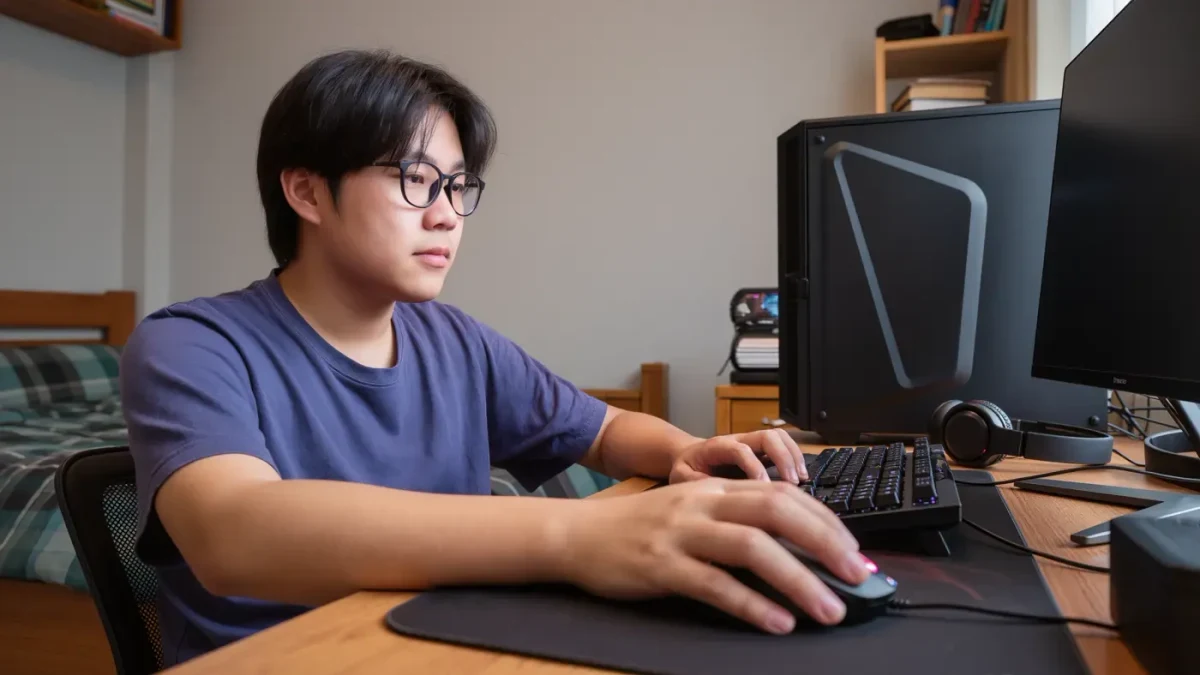
Improve your aim by practicing the right skill deliberately for 15-20 minutes a day, after fixing three settings that cap everything: sensitivity, frame rate, and crosshair placement. Players who train specific components — flicks to static targets, tracking on moving targets, switching between targets — progress faster than players who only play matches, because deathmatch practice mixes aim with positioning, panic, and luck. The evidence from sports training applies here: short, focused, frequent sessions beat long unfocused ones.
This guide covers training method, not health advice. If wrist or arm pain appears during practice, stop and rest — persistent pain deserves a medical professional's opinion, not a sensitivity change.
Why does sensitivity come first?
Muscle memory builds around one sensitivity. Switching weekly resets the calibration. Pick one by feel: low enough that small aim adjustments are precise, high enough that a single comfortable mouse swipe turns you about 180 degrees. Most serious players land between roughly 20 and 50 centimeters per 360-degree turn. Lock your in-game sensitivity and Windows pointer settings, disable mouse acceleration everywhere, and give any change at least a week before judging it.
What gear actually matters?
Less than marketing suggests. A mouse that fits your grip, a large pad for low sensitivity, and a frame rate comfortably above 60 — those matter. A 1,000 Hz polling mouse and a decent sensor are standard on inexpensive pads now. What kills aim at the hardware level is usually software: acceleration, heavy background processes, or a frame rate that swings. Fix the system before buying anything.
What are the three aim skills?
Flicking: snapping to a target and correcting — trained by clicking small static targets quickly. Tracking: keeping the crosshair on a moving target smoothly — trained by strafing bots without clicking, just following. Target switching: moving between multiple targets with rhythm — trained by scenarios that spawn targets in sequence. Each is separate; most players are strong at one and weak at another, and identifying the weak one is where the gains hide.
What does a daily 20-minute routine look like?
Five minutes of warm-up flicks on small targets. Five minutes of tracking a single moving target, no clicks. Five minutes of target switching at a pace slightly faster than comfortable. Five minutes of applying it — a deathmatch or range session where you consciously practice crosshair placement rather than playing to win. Aim trainers like KovaaK's and the free Aimlabs exist for exactly this structure; both ship community routines for specific games.
Why does crosshair placement beat raw aim?
Because the best flick is the one you do not need. Keep the crosshair at head height, pre-aimed at the corner an enemy will appear from, and every duel starts half-won. It costs nothing mechanically — it is a habit, built by consciously correcting the crosshair every time you round a corner in matches. Players at every level lose more fights to crosshairs pointed at the floor than to slow reflexes.
How do you stop overflicking or underflicking?
Overshooting means sensitivity is effectively too high for that distance or you are tensing — grip the mouse lighter, move from the elbow for large motions and the wrist for small. Undershooting means the opposite. Do not change sensitivity to fix tension: drop the scenario difficulty until you hit cleanly at 80 percent, then raise it. Accuracy first, speed second — speed arrives on its own with clean reps.
Should you copy pro settings?
Only as a starting point, not a destination. Pros' sensitivities, resolutions, and crosshairs reflect their hardware, desks, and a decade of habit. Copying a full setup invites a two-week regression while your hands recalibrate. If you want a reference, look at the range pros cluster in and choose within it by feel.
How do you measure progress honestly?
Track scenario scores in your trainer week over week, not day over day — daily scores wobble with sleep and mood. Better: record a deathmatch clip monthly and watch it. You will see crosshair placement errors and panic sprays that scores hide. Eight weeks of focused routine visibly changes both; playing matches alone rarely does, because matches let weak habits survive behind wins.
Does your crosshair choice matter?
More than most players credit, because visibility is the whole job. A crosshair you cannot see against the map loses you duels silently. Pick a color that contrasts with every surface in the game — cyan and green work widely — and keep the shape small: a short cross or a dot, without gaps so wide the center vanishes. Turn off animation and outlines unless they genuinely help you track it mid-fight. Spend five minutes in a custom game against light and dark backgrounds, then stop tweaking; a crosshair you forget about is the goal.
What about aim assist on controller?
Controller aim is a different skill with different training: stick discipline, dead-zone tuning, and using aim assist windows by keeping targets near center rather than dragging through them. Gyro aiming, where supported, bridges the gap and trains closer to mouse mechanics. The routine structure — isolate, drill, apply — is identical.
For more context, read How to Use a Controller on PC for Any Game.
For more context, read how to fix high ping.
For more context, read How to Reduce Input Lag When You Game.