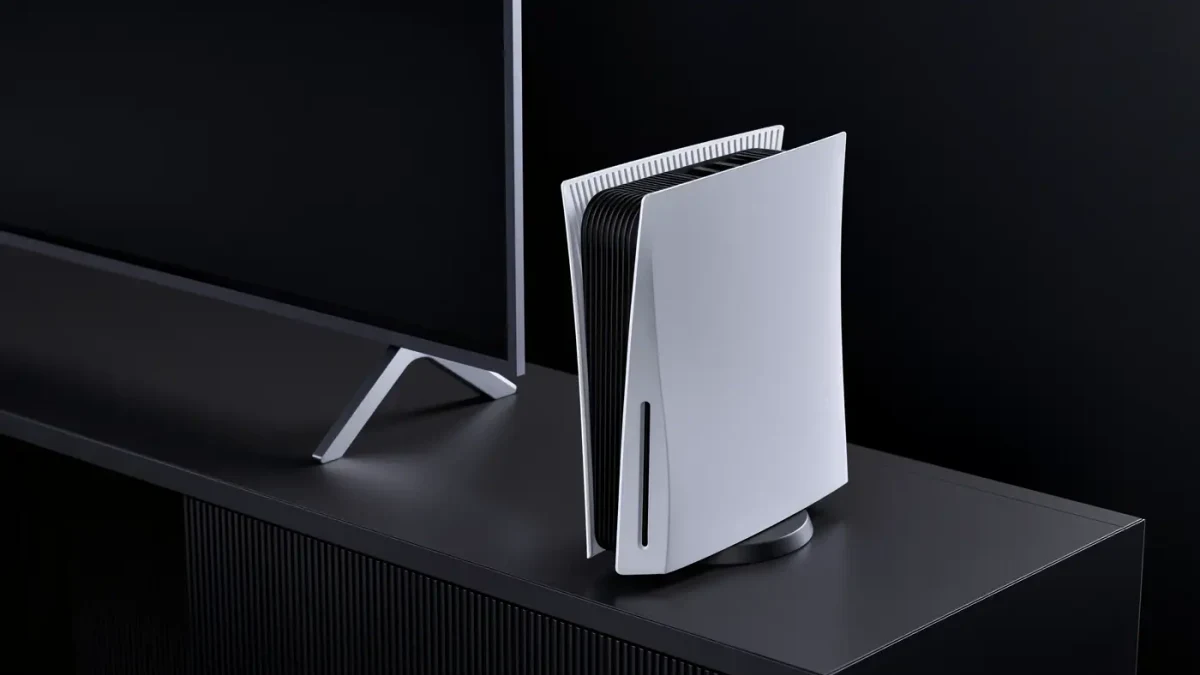
The PlayStation 5 Pro, released November 7, 2024 at $699.99, is Sony's mid-generation upgrade for the base PS5. Sony's own launch materials quoted up to 45% faster rendering than the standard console, plus upgraded ray tracing and a machine-learning feature called PSSR that reconstructs sharp images from lower-resolution frames. The honest summary: the Pro buys better image quality and frame rates in supported games. It does not buy exclusive titles, shorter load times you will feel, or a new generation — every Pro game must still run on the 2020 console sitting beside it on the shelf.
What hardware changed inside the Pro?
Three upgrades matter. The GPU is roughly 67% larger in compute units than the base PS5's, which is where the 45%-faster rendering figure comes from. The memory got a modest boost — 2 GB of extra GDDR6 reserved for system use, easing a real bottleneck in the base console. And the Pro adds dedicated hardware for PSSR (PlayStation Spectral Super Resolution), Sony's AI upscaler, which lets games render internally at a lower resolution and reconstruct it to 4K with far less visual cost than classic upscaling. What did not change: the CPU and the SSD. The disc drive is gone from the standard Pro package — it can be added with the same detachable drive sold for the 2023 slim PS5.
What does that mean in actual games?
Before the Pro, PS5 players often chose: sharp 4K at 30 frames per second, or a softer image at a smoother 60. The Pro's pitch is removing that trade-off — 60 fps or higher with image quality near the Quality mode, because the bigger GPU and PSSR absorb the cost. Sony also reported 8–15% faster frame rates in games that were already CPU-limited, thanks to higher-clocked CPU modes and the extra memory. Ray tracing sees the largest gains: Sony said enhanced games run ray-traced effects at up to three times the speed of the base console. The catch is the word "enhanced" — each game needs a patch. Dozens of titles were patched around launch, and more followed, but an unpatched game on a Pro looks and runs like it does on a standard PS5.
Who should not buy one?
Anyone whose TV tops out at 1080p, plays mostly competitive esports titles already locked at high frame rates, or waits for deep sales. The Pro has no exclusive games and never will — that is the point of a mid-generation refresh. It also does not improve loading: the SSD is effectively the same, so install times and level loads feel identical. And at $699.99 without a disc drive or a vertical stand included, it costs more than a launch PS5 and a stack of games. If you own a working base PS5 and you are happy with how your games look, the Pro is a luxury, not a correction.
Who is it genuinely for?
The Pro fits three profiles. First, players with a 4K 120 Hz TV who feel every dropped frame — the combination of PSSR and the larger GPU is aimed squarely at that screen. Second, players sensitive to 30 fps image quality modes who want their big single-player titles at 60 without the blur. Third, anyone buying their first PS5 in late 2025 or 2026 who plans to keep it for years and would otherwise wonder about the upgrade later. In that last case the real comparison is not Pro versus your old console but Pro versus a $499 base model — and $200 is a lot of game budget.
How does the Pro compare to Microsoft's answer?
It does not have one this generation. Microsoft shipped the mid-generation Xbox One X in 2017 but stayed with the base Series X and the cheaper Series S in the 2020 generation, choosing to invest in Game Pass and cloud streaming instead of a Pro-tier box. That makes the PS5 Pro the only current-generation refresh on the market. Xbox's messaging since 2024 — day-one PC releases and select first-party games on rival consoles — points the brands in different directions: Sony selling a premium box for its exclusives, Microsoft selling a service. Whether the Pro strategy pays off is visible in Sony's public financial reporting on hardware sales, covered by Bloomberg's technology desk.
Is the Pro the end of the generation?
Historically, a Pro console signals the second half, not the finish. The PS4 Pro arrived in 2016, three years into a seven-year generation; the PS5 Pro arrived at the same point in 2024. Expect several more years of games that ship for both the base PS5 and the Pro before a PlayStation 6 resets everything. If you buy a Pro in 2026, you are buying the mature version of a platform with years of releases still ahead of it — the safest point in the cycle to spend premium money, provided the image-quality gains are worth $200 to your eyes and your TV can show them.
For more context, read PlayStation 5 vs Xbox Series X in 2026: Which Console Should You Buy?.
For more context, read console generations.
For more context, read console exclusives 2026.