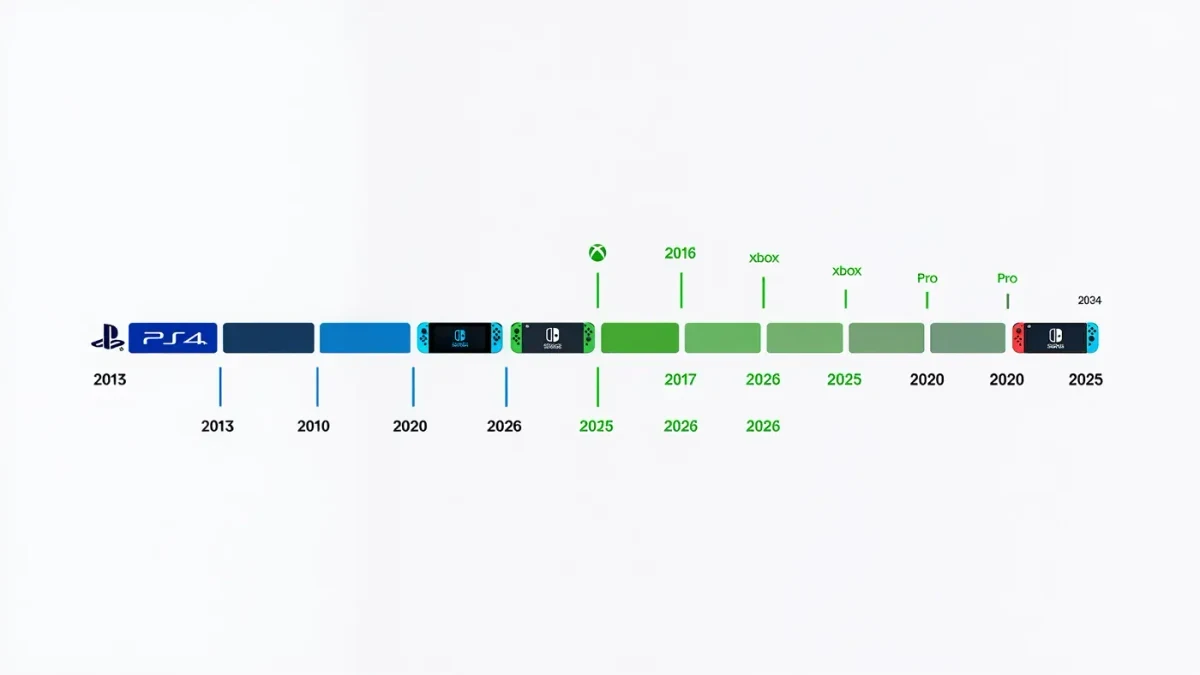
A console generation is a batch of machines with the same architecture, launched around the same time, that share a game library until the manufacturer retires them. The current one — PlayStation 5, Xbox Series X|S, and now the Nintendo Switch 2 — began in November 2020 (June 2025 for Nintendo), and the industry's history says a generation lasts about seven years before a successor resets the clock. That cycle is why your games get cut off, why exclusives cluster at launch, and why mid-generation upgrades like the PS5 Pro exist at all.
What actually defines a new generation?
Three things, in practice. First, a new base hardware platform: the PS5's SSD and CPU were such a leap that PS4 games needed engineering work to run, not just a patch. Second, a software cutoff: games built only for the new machines stop working on the old ones — the Xbox Series S|X and PS5 both reached that point with major 2023–2024 releases. Third, a reset of the installed base: every generation starts at zero sales, which is why the first two years are a land grab for exclusives and launch-window games. Nintendo runs its own schedule: the Switch arrived March 2017, the Switch 2 in June 2025, with a hybrid handheld-home design that ignores the raw-power race entirely.
Why do generations last about seven years?
Economics, not physics. A console is typically sold at or near a loss early on, and the maker recovers the cost through game sales and subscription fees over the machine's life. Seven years is roughly the time it takes to amortize the design, sell 50–100+ million units, and give developers time to learn the hardware — the best-looking games of a generation usually arrive in years four through six, not at launch. The PlayStation 4 (2013–2020) and the Xbox One (2013–2020) both fit the pattern, and the Switch's 2017–2025 run landed at eight. The people who plan and report on these cycles — company earnings, launch dates, shipment numbers — are covered routinely by outlets like BBC News technology.
What is a mid-generation refresh?
A refresh keeps the same generation alive with better hardware that plays the same games. Sony did it with the PS4 Pro in 2016 and again with the $699.99 PS5 Pro in November 2024; Microsoft did it with the Xbox One X in 2017. Refreshes exist because 4K TVs arrived mid-cycle, not because the old console stopped working. Developers must still support the base model, so a Pro buys you higher frame rates and nicer image quality, never exclusive games. The other flavor of refresh shrinks cost: the PS5 slim revision of 2023 replaced the launch model at the same price with a detachable disc drive.
Why did cross-generation games become so common?
Because installed bases are money. When a new generation starts, tens of millions of people still own the old machine, so publishers release many big titles on both — Horizon Forbidden West and God of War Ragnarök shipped on PS4 and PS5 in 2022, and Microsoft's biggest 2020–2022 releases ran on the Xbox One alongside Series X|S. The practice fades as the old base shrinks; by 2024 most major third-party releases had dropped the PS4 and Xbox One versions. If you buy a game labeled cross-generation, expect the old-console version to be the visually weaker port of the two.
How do generations end?
Quietly, through production and store decisions rather than announcements. Manufacturing of the old console stops — Sony ended Japanese PS4 production at the end of 2022, for example — then stores sell through remaining stock, then new releases dry up. Support continues for years after that: the PS4 and Xbox One still received online service and late ports into the 2020s, and both the PS5 and Xbox Series machines are backward compatible with the previous generation's library. Backward compatibility, once a bonus, is now close to an expectation: the Switch 2 plays nearly all original Switch games, and that fact was central to its June 2025 launch.
Where do hybrid consoles fit the pattern?
Nintendo treats the concept loosely. The Switch and the Switch 2 are hybrid machines — handheld first, docked to a TV second — so they never match the raw specifications of the PlayStation and Xbox boxes of their era. What they still share with a traditional generation is the underlying pattern: a shared game library, an eventual software cutoff for the older machine, and a reset of the installed base when the new one arrives. The lesson is that a generation is defined by compatibility and library, not by how powerful the hardware is.
Does any of this change how you should buy?
It sets your clock. Buy early in a generation and you pay full price for a machine whose best games are years away; buy in years four to six and you get the mature library, the mid-generation hardware option, and incoming price cuts. The one thing history argues against is buying a console in its final two years expecting a long runway of new releases — that is when development has already moved to the successor. Generation timing will not tell you which console to buy, but it tells you when buying is cheapest per year of use.
For more context, read Backward Compatibility: How Consoles Run the Previous Generation's Games.
For more context, read ps5 vs xbox series x.
For more context, read console exclusives 2026.