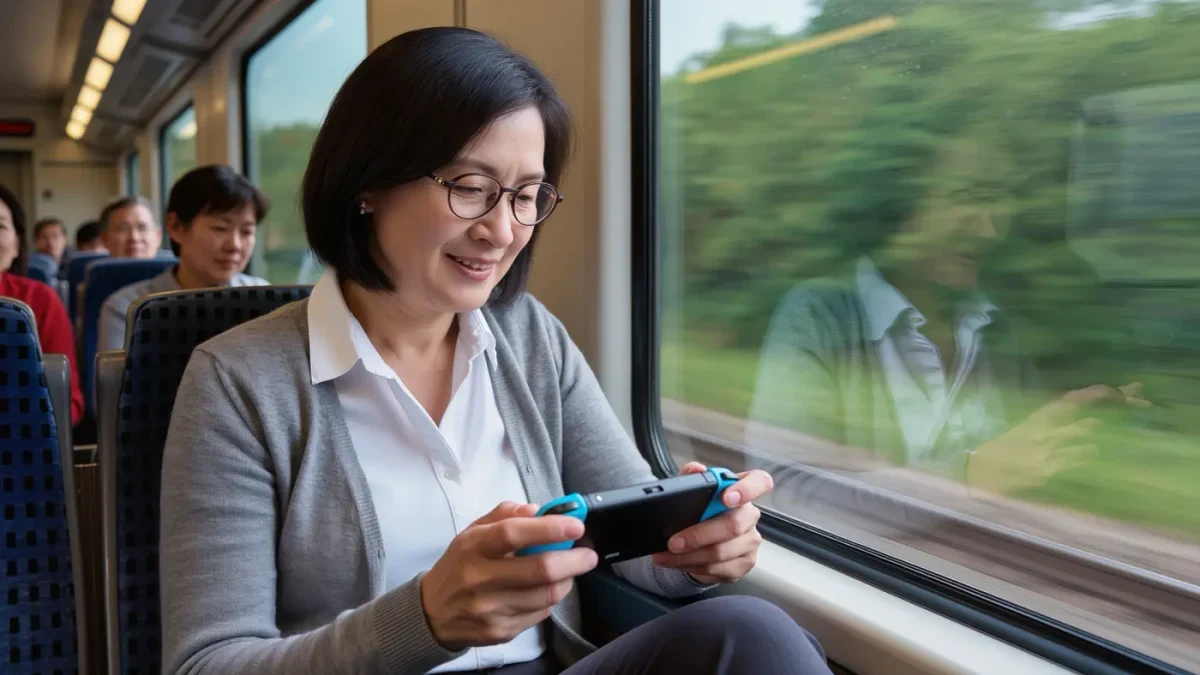
Handheld mode and docked mode run the same games on the same device, but they are not the same experience. A hybrid console docked to a TV renders at higher resolutions — up to 4K on the Switch 2 — while in handheld mode the same machine targets 1080p on its own screen to protect battery, which lasts roughly 2 to 6.5 hours per Nintendo's published Switch 2 specs. Neither mode is "correct": the right answer depends on where your free time happens, what screen you own, and how much you care about image quality versus convenience.
What actually changes between the two modes?
Three things: resolution, performance targets, and control. Docked, the console draws wall power and pushes its best output — the Switch 2 supports up to 4K and up to 120 Hz modes on the TV. Undocked, it drops to its built-in 7.9-inch 1080p screen, caps frame rates lower in most titles, and throttles performance to stretch the battery. Controllers change too: docked play uses detached controllers from across the couch, while handheld play uses the attached Joy-Con form factor, which is where hand size starts to matter — the Switch 2's slightly larger controllers were a direct response to comfort complaints about the 2017 original. Loading times are effectively identical; the SSD does not care where you sit.
Why does battery life dominate handheld play?
Because the battery is the one component that scales with use, not with settings menus. Demanding games drain a full charge in two to three hours; lighter indie titles can run six or more. The practical habits that follow are well established among handheld players: charge top-ups during breaks, brightness lowered, airplane mode on for offline games, and the recognition that a long-haul flight with a AAA title means packing a charger. The dock has no such constraint — a docked console behaves like a fixed home machine with no power anxiety. If your play sessions happen in 45-minute pockets scattered through a day, that difference matters more than any spec sheet suggests.
What about image quality on a big screen?
This is where the honest trade-off lives. Hybrid consoles are portable-first designs, and even docked they do not match a PlayStation 5 or Xbox Series X: a docked Switch 2 renders up to 4K, but many games use dynamic resolution or upscaling to get there, and first-party Nintendo titles prioritize art style and frame rate over raw fidelity. If your main screen is a 65-inch 4K TV and maximum visual detail is why you play, a dedicated home console or PC remains the stronger tool. If your TV is shared, or your gaming time competes with family streaming schedules, the handheld screen stops being a compromise and becomes the feature.
Which games suit each mode?
Some genres map cleanly onto one mode. Turn-based games, puzzle games, visual novels, and run-based roguelites are handheld natural fits — sessions fit the battery, and precision input matters less. Fast competitive shooters, racing games at high frame rates, graphically heavy open worlds, and anything with onscreen text designed for couch distance play better docked. Local multiplayer splits the difference sharply: docked is the only way to get four people around one screen with detached controllers, while handheld multiplayer means passing one device or linking multiple consoles. Check how a specific game handles the switch mid-session, too — most pause and re-sync cleanly, but a few online titles restrict mode changes during play.
Do dedicated handhelds change the math?
For PC players, yes. The Steam Deck, launched in 2022, and the wave of Windows handhelds that followed put a full PC library in portable form, and their existence widened the audience for handheld gaming well beyond Nintendo's ecosystem. A Steam Deck is not competing with a docked PS5 — it competes with a gaming laptop, trading screen size for couch-and-commute flexibility. The 2025–2026 landscape therefore offers three distinct paths: a hybrid console that does both modes adequately, a dedicated home console that does one mode best, and a handheld PC that ports your existing library anywhere. The rise of all three has been a running theme in mainstream games coverage, including at BBC News technology.
How do you decide without buying twice?
Audit a normal week honestly. Count the hours you could realistically play away from your best screen — commutes, lunch breaks, travel, the couch while someone else watches TV. If that number is large, handheld mode is not a bonus feature; it is where you live, and a hybrid or a dedicated handheld should lead the shortlist. If most of your play is deliberate evening sessions at one TV, buy for that screen: a home console or a good PC. And if you genuinely split down the middle, the hybrid design is the product built for you — that is exactly the customer the Switch line has served since 2017, with the Switch 2's bigger, sharper 1080p screen acknowledging that handheld play stopped being the secondary mode long ago.
For more context, read Nintendo Switch 2 First Months: What Launch Actually Delivered.
For more context, read console exclusives 2026.
For more context, read backward compatibility consoles.